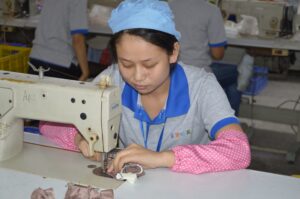

Quality Control
Custom Plush Toys (Sample Approval → Mass Production) Complete Manufacturing Process and Quality Control Standards
Phase One: Aligning with Client Needs and Standardizing Processes (Quality Control from the Start to Prevent Errors)
Customer input: product reference images, design ideas, purpose, target audience, quantity, budget, and delivery date.
Main Goal: Turn the customer’s vague ideas into clear, standardized production parameters that the factory can easily follow, eliminating any misunderstandings.
1. Complete Information Collection and Confirmation
- Basic Product Information: Toy dimensions (default customer size or custom length, width, and height), design style (chibi, realistic, cartoon, trendy), and target audience (infants, adult gifts, or corporate IP). Please note that infant toys must strictly meet higher safety and quality inspection standards.
- Material requirements: Preferred fabrics include short plush, crystal microfleece, sherpa, velvet, and Korean velvet. Please specify if waterproofing, anti-static treatment, or shedding resistance is needed.
- Details and craftsmanship requirements: facial features style, embroidered or printed logos, printed patterns, accessories like bows, pendants, zippers, and whether custom shapes are needed (such as unique limbs, 3D ears, or tails).
- Functional requirements: standard static style, sound, lighting, heating, built-in beads, weighted, and movable joints.
- Quality Standards: We adhere to domestic common standards, children’s toy 3C standards, export CE/ASTM standards, and strict requirements such as no fluorescent agents, no formaldehyde, and water resistance.
- Order details: quantity, delivery schedule, packaging requirements, acceptance criteria, and terms for deductions or compensation.
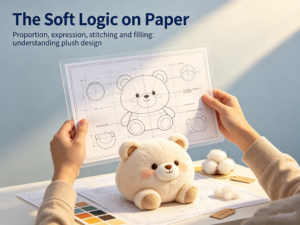
2. Finalize the standardized drawings
- Based on the customer’s photos and ideas, create front, side, and back views with accurate dimensions, proportions, fabric areas, and process details clearly marked.
- Clearly distinguish between fixed areas (customer’s finalized logo, exclusive design) and adjustable areas (fabric texture, stitching details).
- Generate a Custom Product Process Confirmation form that includes the size chart, fabric swatches, thread colors, process checklist, accessory list, and safety standards. Send it to the customer for signature approval. Only after all details are confirmed can we proceed to the sample-making stage, ensuring there are no disputes from verbal agreements.
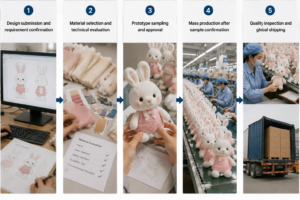
3. Pre-Production Risk Assessment (Factory Side)
- Process feasibility: Whether complex shapes, detailed printing, and small facial features can be mass-produced. Inform the client in advance about any process limitations and discuss necessary adjustments for details that can’t be achieved.
- Cost Calculation: Provide accurate quotes based on fabric, craftsmanship, and quantity, distinguishing between sample and mass production prices.
- Lead time assessment: Break down the time needed for sampling, material cutting, production, quality inspection, and packaging to confirm the final shipping date.
Phase Two: Sample Production + Quality Control (Final Approval, the Only Reference for Mass Production)
The sample represents the production standard for the entire order. All bulk shipments must be a 1:1 match with the approved sample. Production is not allowed without sample approval.
2.1 Sample Creation Process
- Material Selection: We strictly choose fabrics, accessories, fillings, and sewing threads according to the confirmed process sheet, matching color cards to meet the customer’s requirements.
- Handcrafted Pattern Making: Our skilled paper craftsmen create precise patterns based on the three-view drawings, ensuring the shape, curves, and symmetry perfectly match the original design.
- Cutting pieces, hand stitching, shaping the filling, sewing facial features, and attaching accessories—all completed the first prototype.
2.2 Comprehensive Quality Inspection of Samples
- Appearance: The overall proportions, body shape, facial features, and the symmetry of the ears and tail perfectly match the customer’s reference image, with no distortion or misalignment.
- Fabric quality: The fabric has an even color with no discoloration, no shedding, and no stains. It feels soft and meets the agreed-upon standards.
- Craftsmanship details: The stitching is even and tight, with no skipped or loose threads, and no fraying. The edges are clean and smooth.
- Quality and Safety Control: All loose threads are completely removed, with no sharp or hard parts and no risk of unraveling. Infant samples contain no small or easily detachable components.
- Function Test: Samples with sound, lighting, and built-in features are tested repeatedly at least 10 times to ensure stable and fault-free performance.
2.3 Client Approval of Final Draft
- Take high-resolution photos and videos of the samples from multiple angles, highlight any adjustable details, and share them with the client for confirmation.
- The client provided feedback, and we revised the sample until it was 100% finalized and approved.
- Keep one physical final sample each from the factory and the customer, along with the process documents, color samples, and drawings. These will serve as the sole acceptance standards for the bulk order.
Phase 3: Pre-Production Quality Control Preparation
Once the samples are confirmed, we’ll begin the preparations for mass production, ensuring that raw materials and equipment meet our standards right from the start.
3.1 Incoming Raw Material Inspection (IQC Quality Check)
All incoming materials must undergo full or random inspection. Any materials that fail quality checks will be returned immediately and are strictly prohibited from being used in production.
- Fabric Inspection: Check for color differences between batches, shedding, stretch, any damage or stains, and uneven thickness. For eco-friendly fabrics, verify the test reports (no formaldehyde, no fluorescent agents).
- Filling inspection: PP cotton should be fluffy, clean, free of impurities and clumps, and must not contain any low-quality or recycled cotton.
- Accessory Inspection: Check that buttons, eyelets, noses, zippers, and pendants are securely attached; ensure embroidery thread and stitching colors match the sample.
- Printing/Embroidery Materials: The logo and design should be sharp, colors accurately reproduced, with no misalignment or blurriness.
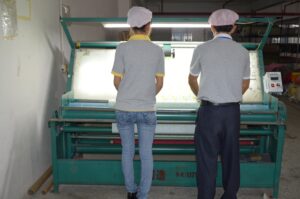
3.2 Die Cutting and Paper Grid Curing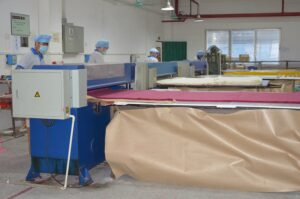
- Standardize the mass-produced paper grids and die cuts so that all cut pieces share the same template and dimensions, ensuring consistency in size, curve, and shape across the entire batch.
- First, we’ll do a sample cut and test run, check the measurements, fit, and color accuracy. Once everything is confirmed, we’ll proceed with mass production.
3.3 Pre-Production Workstation Briefing
For all workstations—cutting, sewing, embroidery, stuffing, shaping, and packaging—we provide a unified explanation of process standards, key precautions, and quality inspection points. Each person receives their own process confirmation form.
4. Phase Four: Full-Scale Production Process with Step-by-Step Quality Control
We follow a strict assembly line process: cutting → embroidery and printing → sewing → fabric inspection → stuffing and shaping → facial feature installation → ironing and shaping → final inspection → packaging. Each step includes self-checks and cross-checks to ensure quality.
4.1 Cutting Process & Quality Control Standards
- Process: Lay the fabric flat and smooth without stretching or slanting. Use precise die-cutting, then sort and label each piece by number.
- Quality Control Highlights: Cut pieces must have size variations within 1mm, with no frayed edges, missing sections, stains, incorrect pieces, or omissions. Pieces from the same part should be exactly the same size. The pattern direction should be consistent (for plush fabrics, the nap should go the same way) to prevent any color difference issues.
- Defective pieces are immediately marked and separated to prevent them from moving on to the next process.
4.2 Embroidery/Printing Process & Quality Control Standards
- Embroidery: Stitches are tight and even, the design is centered and symmetrical, with no skipped or missed stitches, no loose threads, and clean, neat edges.
- Screen printing/offset printing: The design is sharp, colors match the sample exactly, with no smudging, misalignment, color gaps, or scratches.
- Quality Control: All pattern placements are strictly aligned with the final sample. Any deviations beyond the tolerance will be scrapped and redone.